
Apartments and penthouses in central city locations are considered an attractive option for anyone looking to buy apartment in Dubai – both for owner-occupiers and for investors seeking to benefit from the city’s dynamic real estate market.
Dubai has developed into one of the world’s leading international residential real estate hubs. In numerous districts, high-quality apartment towers are being built, featuring modern architecture, extensive community facilities and impressive views of the skyline, waterfront or golf courses. Projects in locations such as Downtown Dubai, Dubai Marina and Business Bay in particular attract international buyers who value central locations, well-developed infrastructure and a high-quality lifestyle when they buy apartment in Dubai.
Apartments also play a key role in the city’s real estate market from an economic perspective. Due to strong demand from international professionals, entrepreneurs and expats, buyers who choose to buy apartment in Dubai often benefit from stable rental demand and attractive return potential.
This guide explains how the process to buy an apartment in Dubai works, which apartment and penthouse types are especially in demand, which districts are most suitable for buyers and what price ranges and additional costs should be expected. In addition, readers from the DACH region will gain insight into the specific aspects that need to be considered when planning to buy apartment in Dubai.
All Euro values are calculated using an indicative exchange rate of 1 AED ~ 0,237 € (as of March 2026). Figures are for illustrative purposes and may vary depending on market fluctuations.
The focus of this article is specifically on apartments and penthouses in Dubai. For a general overview of a property purchase, read our guide “Buy Property in Dubai“. For more information on villas and townhouses, see the article “Buy House in Dubai“.
Table of Contents

Buy apartment in Dubai 2026: Short overview
Buying apartment in Dubai in 2026 remains one of the most attractive options for international buyers seeking a modern city property – whether for personal use or as an investment with solid rental potential.
The following table provides an overview of the key factors to consider when planning to buy apartment in Dubai:
| Factor | Overview |
| Property Type | Full ownership in designated freehold zones |
| Typical Apartment Types | Studios, apartments, penthouses, serviced apartments |
| Entry Price (Studio) | From approx. 500.000 AED (~ 118.500 €) |
| Entry Price (Apartment) | From approx. 800.000 AED (~ 189.600 €) |
| Rental Yields | Typically around 5 – 8 % per year |
| Additional Purchase Costs | Approx. 6 – 8 % of the purchase price |
| Popular Residential Areas | Downtown Dubai, Dubai Marina, Business Bay, JVC |
| Usage Options | Owner-occupation, short-term rental or long-term investment |
Why buy an apartment in Dubai? Benefits for international buyers
Many general conditions of the real estate market – such as tax advantages, strong international demand or residency programs – apply regardless of the property type. A detailed overview of these factors can be found in our guide “Buy Property in Dubai.”
When you plan to buy apartment in Dubai, however, different considerations come into play compared with buying a house. Apartments and penthouses are usually located in central city areas, providing access to an urban lifestyle and often offering an easier entry into the city’s dynamic real estate market.
For buyers from Germany, Austria and Switzerland in particular, apartments and penthouses can represent a highly flexible, internationally oriented form of property – suitable both for personal residence and investment purposes.
Central locations and urban living
One of the key advantages when you plan to buy apartment in Dubai is that many projects are located in the city’s central business and lifestyle districts.
Apartments are often found in areas such as Downtown Dubai, Dubai Marina or Business Bay. These districts combine modern residential towers with restaurants, shops, promenades and excellent connections to major business hubs. For many buyers, this means short distances to work, leisure activities and international infrastructure.
Lower entry prices compared to houses
Compared with villas or townhouses, entering the real estate market through an apartment is often significantly more accessible. Many apartments are available starting in the mid-six-digit AED range, while houses usually require substantially higher investment. This makes it easier for buyers with smaller budgets – or investors looking to acquire multiple properties – to enter the Dubai market.
Attractive rental potential for international tenants
Dubai is home to a highly international population. Many expats, professionals and entrepreneurs prefer apartments in central locations.
As a result, there is a consistent demand for rental apartments in many areas. Studios and smaller apartments, in particular, are often highly sought after by long-term tenants as well as short-term renters. For investors, this creates a solid foundation for stable rental income when they buy apartment in Dubai.
Modern buildings with extensive amenities
Many apartment projects in Dubai offer a range of community facilities that are often not found in traditional residential buildings. Typical features of modern complexes include:
These amenities not only enhance the lifestyle of residents but also make apartments and penthouses more attractive for tenants and investors alike.
Lower administrative and maintenance costs
Another advantage of apartments is the comparatively low administrative and maintenance effort. While houses often require upkeep of gardens, outdoor facilities or private pools, apartment buildings usually handle many of these organizational tasks on behalf of residents. For owners, this can significantly reduce ongoing responsibilities.
This is a particularly practical benefit for buyers from abroad who do not occupy their property permanently when they buy apartment in Dubai.
Good liquidity in the apartment market
The apartment market is one of the largest and most active segments of Dubai’s real estate sector. Apartments are in demand among both owner-occupiers and international investors. This broad buyer base often makes it easier to sell apartments compared with more specialized property types.
For investors, this translates into higher market liquidity and a smoother exit strategy when investing in the city’s apartment market.
Large selection of new projects
Dubai is continuously developing new residential projects, including modern apartment towers and mixed-use urban quarters.
This provides buyers with a wide variety of options, such as:
This diversity allows buyers to find a property that suits both their budget and long-term objectives when they buy apartment in Dubai.
Types of apartments when buying in Dubai
When you plan to buy apartment in Dubai, a variety of apartment types are available. These differ mainly in terms of living space, interior features, building type and price range. Unlike houses, apartments are typically located in multi-storey residential buildings or high-rise towers with shared facilities.
The apartment market in Dubai is highly diverse, ranging from compact studios to exclusive penthouses with spectacular views of the skyline or the sea.
For buyers from Germany, Austria and Switzerland, understanding these property types can be especially useful, as each type caters to different target groups, usage options and investment strategies.
Studios
Studios are among the smallest and most common types of apartments when you plan to buy apartment in Dubai. They typically consist of an open living and sleeping area, an integrated kitchen and a separate bathroom.
Typical features:
Studios are often considered an entry point into the Dubai apartment market and are especially attractive to investors due to their strong rental potential.
Apartments with one or more bedrooms
Apartments with separate bedrooms make up the majority of Dubai’s housing offerings. They are suitable both for owner-occupiers and for long-term rentals.
Typical features:
This type of apartment is particularly common in districts such as Dubai Marina, Business Bay and Downtown Dubai, making them highly attractive for buyers who plan to buy apartment in Dubai for personal use or investment.
Serviced apartments
Serviced apartments combine traditional residential living with hotel-like services. They are often managed by hotel chains or specialized operators.
Typical features:
Serviced apartments can be particularly attractive to investors, as the management and rental operations are often handled by the operator, offering a more hands-off investment when buying apartment in Dubai.
Penthouses
Penthouses belong to the premium segment when you plan to buy apartment in Dubai. They are usually situated on the top floors of buildings, offering particularly spacious living areas and spectacular panoramic views.
Typical features:
Many penthouses are located in exclusive residential projects in prime areas such as Downtown Dubai, Palm Jumeirah or Dubai Marina, making them highly sought-after for both personal residence and luxury investment.
More apartment types when buying in Dubai
In addition to the classic categories, there are other special types of apartments, which can be classified differently depending on the project or developer. These options allow buyers to find a property that matches their lifestyle or investment goals when they buy apartment in Dubai.
| Real Estate Type | Short Description | Classification / Segment |
| Loft Apartment | Apartment with high ceilings and open floor plan | Urban design segment |
| Duplex Apartment | Two-storey apartment within a building | Larger living areas |
| Branded Residence | Apartment in cooperation with luxury brands or hotels | Premium segment |
| Sky Apartment | Apartment on upper floors with skyline view | High-priced segment |
| Waterfront Apartment | Apartment with direct view of water or marina | Popular investment situation |
| Garden Apartment | Ground-floor apartment with private garden area | Rare apartment shape |
These special apartment types provide additional opportunities for buyers and investors looking to buy apartment in Dubai, from unique urban designs to luxury and high-end investment options.
The best locations for apartments in Dubai
When buying an apartment in Dubai, location is one of the most important factors. Many apartments are situated in central districts with high demand, excellent infrastructure and attractive leisure options. These residential areas are often close to business hubs, waterways or tourist hotspots.
Different districts cater to different types of buyers – from investors and expats to owner-occupiers. Some areas have become particularly popular for apartments and penthouses due to their amenities and lifestyle offerings.
| Community | Real Estate Type | Particularities |
| Downtown Dubai | Apartments, Penthouses | Close to Burj Khalifa, Dubai Mall and business districts |
| Dubai Marina | Apartments, Penthouses | Waterfront location, Marina Promenade, very international residential area |
| Business Bay | Apartments | Central location on Dubai Canal, many new residential projects |
| Jumeirah Beach Residence (JBR) | Apartments, Penthouses | Beachfront location with restaurants, hotels, and promenade |
| Dubai Creek Harbor | Apartments, Penthouses | New waterfront community with skyline views |
| Jumeirah Village Circle (JVC) | Apartments | Popular residential area with comparatively moderate entry prices |
Downtown Dubai
Downtown Dubai is one of the city’s most prestigious residential areas. The district surrounding the Burj Khalifa combines luxurious apartment towers with numerous shopping, dining and leisure facilities. Many apartments offer direct views of the skyline or Burj Khalifa. Its central location near Dubai Mall and key business districts makes Downtown Dubai one of the most sought-after areas when buying an apartment in Dubai.
Dubai Marina
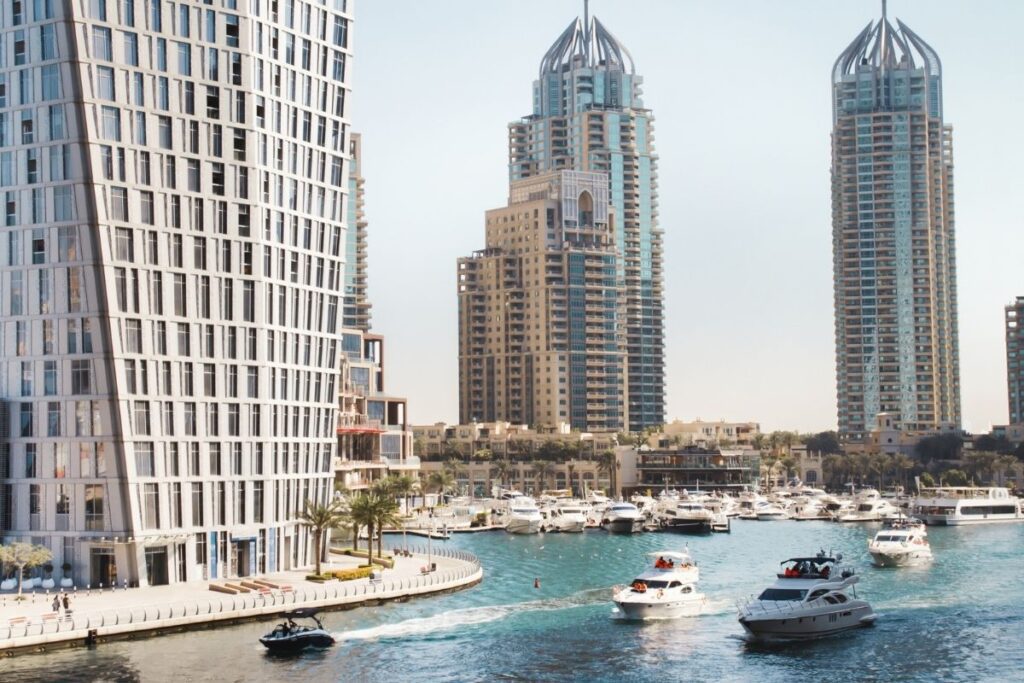
Dubai Marina is a vibrant waterfront district built around an artificial marina. The area is known for high-rise apartment towers and penthouses. The Marina Promenade, lined with restaurants, cafés and shops, creates a lively urban atmosphere, while nearby beaches and Palm Jumeirah provide additional leisure options. For many international buyers, Dubai Marina is a prime location for apartments with strong rental potential.
Business Bay
Business Bay is one of Dubai’s main business and residential hubs, located just south of Downtown Dubai. In addition to numerous office buildings, modern apartment towers along the Dubai Canal are under continuous development. Its central location, modern architecture and good transport connections make Business Bay a sought-after area for those looking to buy apartment in Dubai.
Jumeirah Beach Residence (JBR)
JBR is one of the most famous beachfront locations for apartments in Dubai. Residential buildings line the coast along “The Walk” promenade, surrounded by restaurants, cafés, hotels and leisure facilities. Buyers seeking apartments near the beach often find JBR highly attractive.
Dubai Creek Harbor
Dubai Creek Harbor is a newer waterfront development by Emaar, offering spectacular skyline views. Modern apartment towers, spacious promenades and green spaces define the district. With long-term development plans in place, Dubai Creek Harbor is considered one of the most promising locations for apartments in Dubai.
Jumeirah Village Circle (JVC)
JVC has grown into a popular residential area for apartments in recent years. Situated just outside the city center, it provides good connections to major traffic routes. Many apartment complexes feature medium-sized buildings with communal facilities and green spaces. With comparatively lower entry prices, JVC is especially attractive for investors and first-time buyers looking to buy apartment in Dubai.
Apartment prices in Dubai 2026: Overview
When buying an apartment in Dubai, prices vary significantly depending on the location, building quality, view, living space and interior features. Studios and smaller apartments often serve as entry points into the real estate market, while larger apartments and penthouses in premium locations command substantially higher prices.
Compared with villas or townhouses, the total price of apartments is usually lower, as land is not included in the property value. At the same time, apartments are among the most liquid property types in Dubai, with strong demand from both owner-occupiers and international investors.
The following table provides an overview of typical market prices for apartments in Dubai in 2026:
| Real Estate Type | Typical Price (AED) | Approx. Price (€) |
| Studio (Entry) | From 500.000 – 800.000 AED | 118.500 – 189.600 € |
| 1-Bedroom Apartment | 800.000 – 1.5 million AED | 189.600 – 355.500 € |
| 2-Bedroom Apartment | 1.4 – 2.5 million AED | 331.800 – 592.500 € |
| 3-Bedroom Apartment | 2.5 – 5 million AED | 592.500 – 1.185.000 € |
| Penthouse | From 6 million AED | From 1.422.000 € |
What housing prices in Dubai depend on
In addition to living space, several factors influence the price of an apartment in Dubai. Key considerations include the apartment’s location within the district, its floor level, the view, the reputation of the developer and the amenities offered, such as a pool, gym, concierge or hotel services.
Apartments with sea views, a marina location, or direct views of the Burj Khalifa often command prices well above the market average. Understanding these factors is essential for buyers and investors from the DACH region when planning to buy apartment in Dubai, as they directly affect both purchase costs and rental potential.
Important comparative value: Price per square meter
In the Dubai real estate market, prices are usually quoted per square foot. For buyers from Europe, however, comparison per square meter is often easier to understand.
| Real Estate Type | Approx. Price per sq ft in AED | Approx. Price per m² |
| Standard Apartments | 1.800 – 2.400 AED | 19.400 – 25.800 AED (~ 4.600 – 6.115 €) |
| Waterfront Apartments | 2.400 – 3.400 AED | 25.800 – 36.600 AED (~ 6.115 – 8.670 €) |
| Premium / Penthouse | From 4.000 AED | From 43.000 AED (~ 10.190 €) |
In premium locations such as Downtown Dubai, Palm Jumeirah or Dubai Marina, prices per square meter can be significantly higher than these averages.
Development of housing prices in Dubai
Current market analyses by experts indicate that apartment prices in Dubai remain at a high level. At the beginning of 2026, average sales prices were still around 15 % above the previous year, according to market reports. At the same time, growth has slowed compared with the particularly dynamic years prior.
International observers also note that the real estate market is becoming increasingly segmented. According to analyses referenced by Reuters, certain supply-driven segments may experience more moderate price developments in the future.
For buyers, this means that when planning to buy apartment in Dubai, factors such as location, construction quality, developer reputation, view and building concept are becoming increasingly important. While premium locations and high-quality projects continue to enjoy stable demand, price developments in other segments may vary significantly.
Off-plan vs. existing apartments
When planning to buy apartment in Dubai, the distinction between off-plan projects and existing apartments is an important consideration.
Off-plan apartments are sold directly by the developer and are usually still under construction or in the planning phase, while existing apartments are ready for immediate occupancy.
| Real Estate Type | Price Structure / Characteristics |
| Off-Plan Apartments | Often lower entry price, flexible payment plans over construction period |
| Existing Apartments (Secondary Market) | Usually higher purchase price, ready to move in immediately |
Many investors deliberately choose off-plan projects, as developers often offer long-term payment plans spanning several years, making it easier to enter the market when buying apartment in Dubai.
Apartment locations and price levels
Apartment prices in Dubai can vary significantly depending on the district. Some areas offer comparatively affordable entry points, while others are among the city’s most premium residential locations.
| Location | Price Level |
| Jumeirah Village Circle (JVC) | Affordable to mid-range entry |
| Business Bay | Mid-range to upper segment |
| Dubai Marina | Upscale to luxurious segment |
| Downtown Dubai | Premium segment |
| Palm Jumeirah | Luxury segment |
These differences illustrate how strongly location influences the price when planning to buy apartment in Dubai. Buyers and investors should carefully consider the district, as it impacts both purchase cost and long-term investment potential.

Operating costs when buying an apartment in Dubai
Anyone planning to buy apartment in Dubai should consider the ongoing costs in addition to the purchase price. These costs apply whether the apartment is used personally or rented out.
Compared with houses, apartments generally do not incur expenses for private outdoor facilities such as gardens, pools or extensive maintenance. Instead, buyers should expect ongoing fees for building operation and maintenance, utilities such as electricity, water and cooling and if applicable, administrative services.
While Dubai does not levy a traditional annual property tax, it is important for buyers to realistically budget for regular operating costs. These costs depend on factors such as building quality, location, amenities and apartment size.
Typical operating costs for apartments in Dubai:
| Cost Type | Typical for Apartments in Dubai | Approx. Example Costs |
| Service Charges / Building Fees | Annual, per living space | 3 – 30 AED pro sq ft (~ 32 – 323 AED per m²) (~ 8 – 76 € / m²) |
| Electricity and Water (DEWA) | Monthly, based on consumption | 300 – 900 AED (~ 70 – 215 €) |
| District Cooling | Depending on the building | Varies based on consumption and provider |
| Maintenance within the Apartment | Maintenance and minor repairs | 0,5 – 1 % of the property value annually |
| Property Management (for rental) | Management of the property | 5 – 15 % of the annual rent |
| Home Insurance | Optional | 500 – 2.000 AED annually (~ 120 – 475 €) |
These values are average estimates. Actual costs can vary significantly depending on the building, location and level of amenities.
Service charges in apartment buildings
One of the most important ongoing costs when buying an apartment in Dubai are the so-called service charges. These fees are collected by the building administration and cover the operation and maintenance of common areas and infrastructure.
Typical services financed by service charges include:
In Dubai, service charges are usually calculated per square foot (sq ft) of living space and collected annually.
Typical service charge values:
Luxury apartment towers with extensive amenities – such as rooftop pools, gyms, spas and concierge services – can sometimes have significantly higher service charges.
Electricity and water costs
In Dubai, electricity and water are provided and billed by the Dubai Electricity and Water Authority (DEWA).
Since apartments are generally smaller than houses, monthly utility costs are usually moderate. For many apartments, typical monthly expenses are:
Actual costs depend on several factors:
When activating electricity and water, DEWA requires a security deposit of 2.000 AED (~ 475 €) for apartments, which is refunded upon moving out.
Cooling and District Cooling
Many modern apartment buildings in Dubai use district cooling systems, which are central cooling systems that supply multiple buildings simultaneously.
These costs are usually billed separately from electricity and water and depend on several factors:
Depending on consumption, district cooling costs are charged in addition to DEWA electricity and water fees.
Maintenance within the apartment
In addition to common building costs, apartment owners are responsible for maintenance and minor repairs within their own units.
Typical examples include:
Real estate experts generally recommend budgeting around 0,5 – 1 % of the property value annually for these costs. For an apartment worth 1 million AED, this corresponds to:
Property management for rental apartments
Many international buyers rent out their apartments in Dubai, either long-term or as an investment. In such cases, hiring a property management company is common.
These service providers typically handle:
For classic long-term rentals, management fees usually range between:
For short-term rentals, costs can be higher due to additional services required.
Investors should factor these expenses into their budget when planning to buy apartment in Dubai, as professional property management can significantly simplify the rental process and protect the investment.
Insurance for apartments
Insurance for the interior of an apartment – covering furniture, equipment and interior design – is not mandatory in Dubai but is strongly recommended.
Typical costs are:
The exact price depends on the scope of coverage and the value of the furnishings.
Assessing total operating costs
For many apartments in Dubai, total annual operating costs – including service charges, utilities, maintenance, management fees and optional insurance – typically range between
In premium buildings with extensive amenities or particularly large apartments, these costs can be higher.
Realistic budgeting of these ongoing costs helps buyers better estimate the actual total expenditure when they buy apartment in Dubai, supporting well-informed investment decisions.
In addition to recurring operating costs, buyers should also consider one-off purchase costs. These include Dubai Land Department fees, brokerage commissions, trustee fees and administrative costs for transferring ownership.
A detailed overview of all additional purchase costs when buying property in Dubai can be found in the guide “Buy Property in Dubai.”

Key factors to consider when buying an apartment in Dubai
When planning to buy an apartment in Dubai, several key factors should be carefully considered before making a decision. In addition to location and price, aspects such as the floor plan, building organization, rentability and legal details play a crucial role.
Since apartments are usually part of larger buildings or residential complexes, not only the characteristics of the individual unit influence the property’s value, but also the quality of building management, rental demand and long-term development of the surrounding area. Careful analysis of these factors helps buyers find an apartment that meets both their personal living needs and long-term investment goals.
Floor plan and apartment layout
When buying an apartment in Dubai, the floor plan is decisive for both living comfort and rental potential. Two apartments with the same area can differ significantly in practical usability.
Important points include:
Well-designed floor plans are highly sought after and are often easier to rent out or resell in the future.
Building utilization and number of units
An often underestimated factor is the structure of the building itself. High-rise buildings vary greatly in the number of apartments per floor and the overall size of the complex. Buildings with many units can:
Buildings with many units can:
Buildings with fewer units or professional management usually provide a quieter, more stable living environment.
Parking situation
In many apartment buildings, a parking space is included with the apartment. Buyers should verify the exact arrangements by asking:
In densely urban districts, an additional parking space can represent significant added value.
Ownership structure in the building
The ownership structure within a building can influence both the quality of living and long-term stability. Buildings with a high proportion of long-term owners tend to be more stable than those with frequent short-term rentals or high turnover. A balanced mix of owner-occupiers and investors can contribute to long-term stability.
Demand in the rental market
For buyers looking to invest, analyzing rental demand in the building or district is crucial.
Key considerations include:
Studios and one-bedroom apartments are often particularly sought after, while demand for larger units depends more on the district.
Developer and project history
When buying an apartment in Dubai, it is also advisable to review the developer’s track record. Large developers often undertake multiple projects within the city.
A comparison can reveal:
This information helps assess the long-term attractiveness and investment potential of a project.
Future development of the surroundings
Finally, buyers should consider future development in the area. New infrastructure, transport projects or additional residential and commercial buildings can affect property values over time.
Key points to check include:
Such developments can present both opportunities and risks for the long-term value of the apartment.

The 7 most common mistakes when buying an apartment in Dubai
The real estate market in Dubai operates differently from many European housing markets. International buyers from Germany, Austria or Switzerland often underestimate certain market characteristics.
Anyone planning to buy an apartment in Dubai should be aware of the most common mistakes, as these can significantly affect long-term rental potential, resale value and overall investment strategy.
Conclusion: Is it worth buying an apartment in Dubai 2026?
Buying an apartment in Dubai in 2026 can be an attractive option for both owner-occupiers and investors. Apartments represent the majority of the city’s real estate market and offer a wide range of projects, locations and price levels.
For international buyers, apartments often provide an easy entry into the Dubai real estate market, as they usually have lower entry prices than villas or townhouses, while rental demand remains high. In central districts with good infrastructure, demand from expats, specialists and international companies continues to be stable.
Apartments are also appealing to investors because they are generally more liquid on the resale market compared to larger properties. Many projects benefit from Dubai’s growing population, strong international demand and ongoing urban development.
However, choosing the right property is decisive. Factors such as location within the city, building quality, developer reputation and long-term demand play a key role in both rental performance and potential returns.
Buyers who carefully analyze the market and compare multiple projects can acquire both a flexible capital investment and an international residence when they buy apartment in Dubai.
If you are also interested in emigration, company formation, taxes, living costs or life in Dubai, you will find all the essential information in our Dubai Premium-Guide.
FAQ: Key questions about buy apartment in Dubai
Are there taxes on apartments in Dubai?
When buying an apartment in Dubai, there is no annual property tax and no income tax on rental income. Buyers should, however, consider one-time purchase fees, including the 4 % Dubai Land Department (DLD) fee, as well as ongoing service charges for the building.
Which apartments are most popular with investors in Dubai?
When buying an apartment in Dubai, investors often focus on properties with high rental potential. Studios and one-bedroom apartments in central city districts, especially near metro stations or business hubs, are particularly popular. These units are generally easier to rent out and offer stable rental demand.
Can you rent out an apartment in Dubai?
Yes. Owners can rent out their apartment in Dubai on a long-term or short-term basis. In addition to standard annual leases, short-term rentals, such as holiday homes, are possible if the property has a valid license from the Dubai Tourism Authority (DTCM).
What are typical rental yields for apartments in Dubai?
Rental yields for apartments in Dubai usually range between 5 – 8 % gross per year, depending on location, building quality and demand. Smaller units in high-demand districts can sometimes achieve even higher returns.
How long does it take to buy an apartment in Dubai?
When buying an existing apartment on the secondary market, ownership transfer can often be completed within a few weeks. For off-plan properties, the title is usually registered only after the building is completed.
Can you buy an apartment in Dubai completely online?
Partially, yes. Many steps when buying an apartment in Dubai, such as reservation, document verification and contract signing, can be completed digitally. However, the final ownership transfer usually takes place at an official trustee office of the Dubai Land Department.
Can multiple people buy an apartment together?
Yes. An apartment in Dubai can be purchased jointly by multiple owners, such as spouses, family members or investors. The respective ownership shares are officially registered in the title deed.
How safe is the real estate market in Dubai?
The real estate market in Dubai is one of the more strongly regulated markets in the region. Authorities such as the Dubai Land Department (DLD) and the Real Estate Regulatory Agency (RERA) oversee transactions. For off-plan projects, developers are required to manage buyers’ funds through government-regulated escrow accounts, ensuring additional security for investors.
Data Accuracy & Topicality
The information in this article is based on publicly available market data, current listings for apartments and penthouses in Dubai, industry analyses and official fee and ownership structures from the relevant Dubai authorities (as of 2026).
All figures and assessments are provided for general guidance. Actual purchase prices, operating costs, rental yields and performance when buying an apartment in Dubai can vary depending on location, building, apartment size, developer, construction quality, finishing, equipment, financing, exchange rates and current market conditions.
Especially in the apartment segment, real estate can differ significantly based on building quality, floor level, orientation, view, communal facilities and age of the property. Before making any investment decision, buyers should carefully review project documents, service charge structures, building management and all contractual, legal and tax-related conditions individually.