
Health insurance in Dubai is mandatory: valid cover is generally required for a residence visa to be issued or renewed. The policy must meet the applicable requirements and be recognised in the relevant systems of the United Arab Emirates.
Health insurance in Dubai is not a voluntary extra. The legal basis is Dubai Law No. 11 of 2013. It obliges employers and sponsors to adequately insure the people they employ or sponsor.
Insurance and visa procedures are increasingly linked digitally. Valid health insurance is explicitly listed as a requirement in numerous residence and renewal procedures. If the required proof is missing, the procedure cannot be completed successfully.
For emigrants from Germany, Austria and Switzerland, there is also a second important question: what happens to your existing health insurance when you move your residence permanently to Dubai?
This article therefore shows which requirements apply to health insurance in Dubai and what happens to your existing cover in your home country.
For every step from your decision to everyday life in Dubai, see our guide Moving to Dubai.
Table of contents
Health insurance in Dubai: is it mandatory by law?
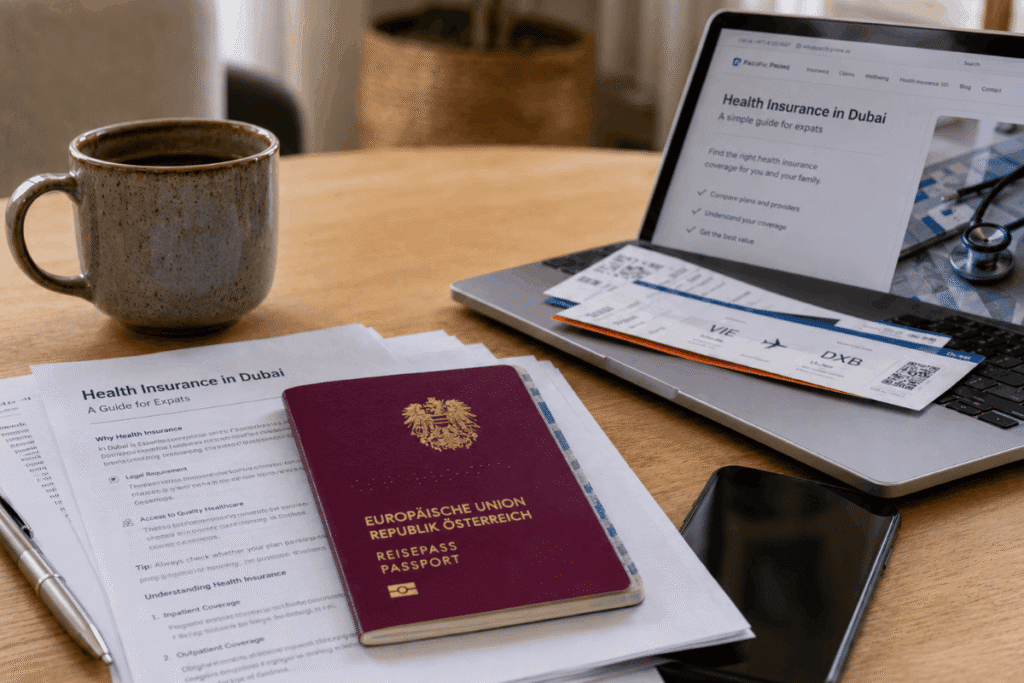
Since Dubai Law No. 11 of 2013, there has been a clear legal requirement for health insurance in Dubai: residents of Dubai must generally have continuous health insurance cover. The insurance must meet the applicable minimum requirements.
This applies in particular to:
- employees,
- self-employed people and freelancers,
- entrepreneurs and investors,
- spouses and children,
- other sponsored family members.
The law obliges employers to insure their employees. Sponsors must generally arrange insurance cover for the people they sponsor who are not already insured through an employer.
The key facts in brief
Proof of insurance: Valid health insurance is one of the requirements in numerous residence visa and renewal procedures. For a renewal, too, the conditions for the original issue must still be met.
Digital checks: Insurance and visa procedures are increasingly linked digitally. This allows recognised policies to be assigned directly to an application and checked by the authorities.
Fine: Employers and sponsors who do not insure employees or sponsored persons with the required basic cover in time can be fined AED 500 per month of delay. This currently corresponds to around €120.
Costs: Simple local policies are usually cheaper than international plans. However, the price alone says little about the actual quality of the cover.
Who pays for health insurance in Dubai?
Who has to arrange and pay for the cover depends on your employment and residence status.
Employees
Employers are generally obliged to take out and maintain compliant health insurance for their employees.
This generally applies regardless of whether you are employed by a mainland company or a free zone company. However, the benefits actually included in the employer’s insurance depend on the plan chosen.
Employer insurance therefore does not automatically meet all personal requirements. There can be considerable restrictions, especially for dental treatment, maternity, mental health, pre-existing conditions or treatment outside the UAE.
You can find more information on employment in our article Working in Dubai.
Spouses and children
Spouses and children are not automatically covered by the employee’s policy.
Anyone who sponsors family members is generally responsible for ensuring that these people also have adequate health insurance cover. Whether the employer voluntarily covers the costs depends on the employment contract and the respective benefits package. When choosing health insurance in Dubai for families, you should check not only the premiums but also paediatricians, maternity benefits and the hospital network.
Before leaving, the following should therefore be clarified in writing:
- which family members are included,
- which benefits are covered,
- whether additional premiums apply,
- from when the cover applies.
Self-employed people, freelancers and investors
Anyone who lives in Dubai through their own company, a free zone licence, an investment or a long-term residence programme usually has to arrange and pay for health insurance themselves.
This also applies to spouses, children and other sponsored family members who move with you. Suitable health insurance in Dubai should therefore be included early in the cost planning for the move and your ongoing stay.
You can find more information on long-term residence options in our category “Visa & Residency”.
Local or international health insurance in Dubai?
There are basically two models to choose from:
- local health insurance for the UAE,
- international health insurance with extended coverage.
Both options can make sense. What matters is how and where the insured person lives, works and travels. When choosing health insurance in Dubai, you should therefore consider not only the costs but also the geographical coverage and the hospital network.
| Feature | Local UAE policy | International policy |
| Coverage area | Usually the UAE or regionally limited | Regional or worldwide depending on the plan |
| Premium | Usually cheaper | Usually considerably higher |
| Hospital network | Limited to contracted facilities | Often a larger international network |
| Customer service | Usually Arabic and English | Sometimes also in German |
| Billing | Often direct billing within the network | Direct billing or reimbursement |
| Suitable for | People living permanently in the UAE | Frequent travellers, families and people with ties abroad |
Local employer insurance may be sufficient for healthy employees living permanently in Dubai. However, you should first check which hospitals you can use and which deductibles apply.
International health insurance can be particularly useful for:
- entrepreneurs and self-employed people,
- people who travel regularly,
- families with children,
- people receiving treatment in their home country,
- people with a greater need for cover,
- people who want to keep a later return open.
Important: An international policy is not automatically recognised for a residence visa simply because of its worldwide coverage. It must also meet the locally required conditions and be accepted in the respective application procedure.
Which health insurance suits whom?
Which solution makes sense depends heavily on your personal circumstances. The following overview serves as a first guide:
| Situation | Often a suitable solution |
| Employee with good employer insurance | Check the employer policy and top it up where needed |
| Self-employed person living permanently in Dubai | Local or international individual policy |
| Family with children | Plan with a large hospital and paediatrician network |
| Frequent travellers | International policy with extended coverage |
| Retirees or people with pre-existing conditions | Individual comparison before the visa application |
The overview does not replace an individual plan review. Before signing, you should check in particular the scope of benefits, deductible, hospital network, pre-existing conditions and geographical coverage.
What does the Essential Benefits Plan cover?
The Essential Benefits Plan (EBP) forms the basic benefits framework for certain basic plans in Dubai.
It was originally developed in particular for lower-income employees.
The current table of benefits is published via the official Dubai health insurance portal.
The basic benefits can include in particular:
- outpatient medical treatment,
- medically necessary inpatient treatment,
- emergency treatment,
- prescription medicines within set limits,
- basic maternity benefits,
- examinations and treatment within the agreed network.
The published EBP benefit tables provide for an annual overall benefit limit of AED 150,000, which corresponds to around €36,000. However, the currently valid table of benefits and the specific insurance contract are always decisive.
These restrictions are important
A basic plan does not mean that all medical costs are covered in full.
Possible restrictions include:
- deductibles for doctor’s visits,
- percentage co-payments,
- limited medication benefits,
- restricted hospital and doctor networks,
- waiting periods,
- exclusions for certain pre-existing conditions,
- limited maternity benefits,
- no or only limited dental treatment,
- no regular treatment outside the UAE.
The EBP should therefore not be equated with comprehensive international cover. Health insurance in Dubai at EBP level meets the basic requirements, but does not automatically offer comprehensive protection.
Health insurance in Dubai: what does it cost?
Costs vary considerably. There is no universally applicable monthly premium.
The decisive factors are in particular:
- Age
- Gender
- State of health
- Existing conditions
- Desired scope of benefits
- Deductible
- Hospital network
- Geographical coverage
- Maternity benefits
- Dental and preventive care
Non-binding cost guide
The following treatment costs are non-binding guide values and are intended as a rough orientation. Hospitals set their own prices; diagnostics, medicines and other services may be charged additionally.
The actual premium for health insurance in Dubai can differ considerably from these guide values depending on the factors mentioned.
| Type of insurance | Rough monthly guide |
| Simple local basic policy | approx. €40 to 70 |
| Local policy with extended cover | approx. €70 to 150 |
| Entry-level international policy | approx. €100 to 250 |
| Comprehensive international policy | approx. €250 to 750 or more |
For older people, pre-existing conditions or worldwide cover including the USA, premiums can be considerably higher than these values.
Families should not simply multiply the individual premium by the number of family members. Different risk assessments and premiums apply to children, adults and older people.
The main price drivers
Age: Premiums often rise considerably with age.
Pre-existing conditions: Depending on the provider, risk surcharges, waiting periods or exclusions may be agreed.
Deductible: A higher deductible often reduces the ongoing premium, but increases your own costs when you need treatment.
Coverage area: A regional plan for the UAE or the Middle East is usually cheaper than a worldwide policy.
Hospital network: Plans with access to well-known private hospitals and international hospital chains often cost more.
Additional benefits: Dental treatment, preventive care, glasses, psychological care and comprehensive maternity benefits increase the premium.
What does medical treatment cost without adequate insurance?
Dubai has numerous modern private hospitals and specialised medical facilities. When comparing health insurance in Dubai, you should therefore also consider possible out-of-pocket costs and treatment costs.
Here too, prices vary considerably depending on the hospital, specialty, treatment and medical effort.
Rough cost guide
| Service | Possible costs without adequate insurance |
| General practitioner consultation | approx. €50 to 130 |
| Specialist appointment | approx. €100 to 250 |
| Emergency department treatment | approx. €150 to 400 or more |
| Inpatient stay per night | from approx. €500 |
| Minor surgical procedure | from approx. €1,500 |
Laboratory tests, imaging, medicines, anaesthesia and additional medical services may be charged separately.
A seemingly cheap policy can therefore become expensive in an emergency. This applies in particular if:
- the preferred hospital is not in the network,
- no approval was obtained before treatment,
- high deductibles apply,
- medicines are only partially covered,
- a condition has been excluded,
- the annual maximum benefit is reached.
How do you find the right health insurance in Dubai?

When choosing health insurance in Dubai, you should compare not only the monthly premium but also benefits, hospital network, deductible and geographical coverage.
1. Recognition for the residence visa
First, you need to clarify whether the policy is accepted for the specific residence and visa category.
Worldwide cover alone is not necessarily sufficient. The provider should confirm in writing that the policy meets the applicable requirements.
2. Direct billing with hospitals
With direct billing, the hospital settles the bill directly with the insurer.
With pure reimbursement plans, insured persons may have to pay for treatment themselves first and then submit the invoices. For expensive treatment, this can lead to a considerable cash-flow problem.
3. Size of the hospital network
Many plans only apply in certain hospitals or with selected doctors.
Before signing, you should check:
- Which hospitals are in the network?
- Are there facilities near where you live?
- Are paediatricians and specialists included?
- Are your preferred private hospitals covered?
- What happens if you are treated outside the network?
4. Deductibles and co-payments
A low premium can come with high co-payments.
Particularly relevant are:
- deductible per doctor’s visit,
- percentage share of medication costs,
- co-payments for specialists,
- deductible for inpatient treatment,
- separate limits for dental treatment.
Anyone who regularly needs medical services may be better off in the long term with a more expensive plan and a lower deductible.
5. Cover outside the UAE
Local policies often apply only within the UAE or only to medical emergencies abroad. Anyone looking for health insurance in Dubai that also covers them in their home country must therefore pay close attention to the geographical coverage of the plan.
Anyone who regularly travels to Germany, Austria, Switzerland or other countries should check:
- whether planned treatment abroad is covered,
- whether only emergencies are covered,
- whether trips home are included,
- whether there is a time limit,
- whether certain countries are excluded.
6. Pre-existing conditions
Pre-existing conditions must be declared fully and truthfully.
Anyone who withholds medical information risks:
- refusal to cover costs,
- subsequent termination,
- exclusions,
- financial claims by the insurer.
A written confirmation of acceptance is particularly important if you already have chronic conditions or ongoing treatment.
What happens to your health insurance in your home country?
Different rules apply to emigrants from Germany, Austria and Switzerland.
Your existing insurance should never be considered automatically terminated simply because you have deregistered your residence. Before taking out health insurance in Dubai, you should therefore clarify when your existing cover actually ends. What matters is the basis of your existing insurance.
Germany: clarify membership in writing
Anyone moving permanently from Germany to Dubai generally cannot rely on the normal benefits of German statutory health insurance in the UAE.
The UAE is neither part of the European Union nor the European Economic Area. There is also no general health insurance agreement comparable to cover within Europe.
You can find more information on health insurance cover outside the European Union from the German consumer advice centre (Verbraucherzentrale) and the German Federal Ministry of Health.
However, whether and when membership of statutory health insurance ends depends on your previous insurance status.
Relevant factors include:
- existing employment,
- voluntary membership,
- receipt of a pension,
- secondment,
- family insurance,
- continued habitual residence in Germany.
Deregistering with the residents’ registration office does not automatically end membership in every case. Your health insurance fund should therefore be informed in writing before you move.
The following documents may usually be requested:
- deregistration certificate,
- proof of your new residence,
- residence or visa documents,
- proof of your new health insurance,
- proof that your German employment has ended.
Only the written confirmation from the health insurance fund provides clarity about the end of membership and contribution liability.
Austria: the basis of insurance is decisive
In Austria, statutory health insurance does not depend solely on your registered residence. What matters is the reason why a person is insured. This includes, for example:
- employment,
- self-employment,
- pension,
- unemployment benefit,
- self-insurance,
- co-insurance as a dependant.
For employees, compulsory insurance generally ends when the employment or entitlement to pay ends. Different rules may apply to self-employed people, pensioners, voluntarily insured persons and seconded employees.
Before moving, you should therefore clarify with the Austrian Health Insurance Fund (ÖGK) or the responsible social insurance provider whether your insurance ends, on what date it ends and which conditions apply if you return later. You can find the responsible contact point via the ÖGK customer service centres.
Written confirmation protects against later misunderstandings or unexpected contribution claims.
Switzerland: basic insurance generally ends when you move away
When you move your residence abroad permanently, compulsory Swiss health insurance generally ends when you leave Switzerland.
Exceptions apply to certain groups of people, for example:
- seconded employees,
- cross-border commuters,
- diplomats,
- people covered by international social security agreements.
Recipients of a Swiss pension living outside the EU, EFTA and the United Kingdom are generally not required to remain insured in Switzerland solely because of their Swiss pension. For residence in Dubai, cover at the new place of residence is therefore normally decisive.
Your departure should be reported to your health insurer in good time and proven with suitable documents.
You can find more information on tax residence, possible exit taxation and double taxation in our article Dubai taxes.
What applies when returning to Germany, Austria or Switzerland?
Your return should also be considered before you move.
With a locally issued UAE policy, cover does not necessarily end automatically on the same day as the residence visa. The policy terms, duration and cancellation rules are decisive.
Returning to Germany
When returning to Germany, you are generally once again required to have adequate health insurance cover.
Whether you are admitted to statutory or private health insurance depends, among other things, on:
- your previous insurance history,
- your age,
- your employment status,
- your income,
- possible self-employment,
- previous private health insurance.
An automatic return to the statutory health insurance you last had is not guaranteed in every case.
Particular caution applies to people aged 55 and over. For them, returning to statutory health insurance can be considerably more difficult or impossible.
Returning to Austria
Anyone who takes up employment subject to compulsory insurance in Austria after returning is generally registered with social insurance again via their employer.
Different conditions apply to self-employment, pension, unemployment, voluntary insurance or no employment.
Returning to Switzerland
Anyone who takes up residence in Switzerland again must generally take out compulsory basic insurance within three months.
If you register in time, cover and the obligation to pay premiums apply retroactively from the start of residence.
If the deadline is missed without good reason, financial disadvantages and a premium surcharge may result.
Practical tip: Your insurance in Dubai should only be cancelled once it is certain from which date your new cover in your home country begins. This avoids a gap in cover.
Special cases: tourists, retirees and newborns
Tourists and visitors
It is not correct to state across the board that tourists in the UAE never need proof of insurance.
Valid health insurance is explicitly listed as a requirement for various visit and tourist visas. For the long-term multiple-entry tourist visa, for example, the insurance must be issued within the UAE and have a specified period of validity.
The specific requirement depends on:
- nationality,
- type of entry,
- length of stay,
- visa category.
Even people who may enter without applying for a visa in advance should take out good travel health insurance.
However, travel health insurance for a tourist stay is not automatically suitable for a later residence visa.
Retirees moving to Dubai
Retirees applying for a residence visa must meet the insurance requirements applicable to their residence category.
As no employer provides the insurance, the policy normally has to be arranged and paid for by yourself.
Particularly important are:
- entry age,
- existing conditions,
- current medication,
- waiting periods,
- exclusions,
- annual maximum benefits,
- inpatient care,
- cover during trips home.
Health insurance in Dubai for retirees should therefore be compared individually before applying for the residence visa.
Newborns in Dubai
Under the EBP requirements, newborns are generally covered by the mother’s policy for the first 30 days after birth. However, the specific contract terms and benefit limits remain decisive.
Within this period, a separate policy should be set up for the child or the child should be added to a family plan.
Birth certificate, passport, residence visa, Emirates ID and health insurance are connected but legally separate administrative steps. It should therefore not be claimed across the board that no birth certificate or passport can be issued without a separate policy.
The required documents and deadlines should be agreed with the hospital, insurer and responsible authority immediately after the birth.
Common mistakes with health insurance in Dubai
Mistake 1: Only considering the visa requirement
Health insurance in Dubai can be sufficient for the visa application and still offer very limited practical protection.
Dental treatment, maternity, psychological care, preventive care and treatment outside the UAE in particular are often restricted in simple plans.
Mistake 2: Only comparing the monthly premium
A low premium can come with high deductibles, a small hospital network or low benefit limits.
You should therefore always compare the total potential financial burden. Cheap health insurance in Dubai can become expensive in the long run if there are high deductibles or important exclusions.
Mistake 3: Not actively clarifying your insurance in your home country
Simply deregistering your residence does not automatically end your insurance in every country and for every insurance status.
Without written clarification, unnecessary contributions or later back-payment claims may arise.
Mistake 4: Forgetting family members
Spouses and children are not automatically covered by the main policyholder.
For each sponsored person, you must check whether a separate policy is required.
Mistake 5: Withholding pre-existing conditions
Incomplete health information can lead to considerable problems when you make a claim.
All known diagnoses, treatments and medicines should be declared in full.
Mistake 6: Not checking the hospital network
Not every policy applies in every hospital.
Anyone who wants to use a particular private hospital or doctor should check the network before signing.
Mistake 7: Not planning for your return
A later return to your previous insurance system is not always automatically possible.
This applies in particular to older people, self-employed people and those previously privately insured.
Conclusion: the three most important steps before the move
Health insurance in Dubai is not an optional extra. Valid and recognised health insurance cover must be proven for numerous residence visas to be issued or renewed.
Insurance and visa procedures are increasingly linked digitally. This makes it all the more important to take out health insurance in Dubai in good time and to make sure it is suitable for your specific residence category.
1. Compare benefits before price
Monthly premiums are not the only thing that matters.
In particular, you should check:
- direct billing,
- hospital network,
- deductible,
- medication benefits,
- inpatient treatment,
- maternity,
- pre-existing conditions,
- cover outside the UAE.
2. Clarify your insurance in your home country in writing
Different rules apply in Germany, Austria and Switzerland.
Your existing cover should not simply continue, but should not be cancelled prematurely either. The responsible insurer should confirm the end date in writing.
3. Consider a possible return from the start
Cancellation periods for the Dubai policy and the conditions for readmission in your home country should be known before you leave.
People aged 55 and over, retirees, self-employed people and those with private insurance in particular should check this point early.
You can find more information on visas, residence, work, taxes and the practical side of the move in our Dubai guides.
Matching tools
Your insurance premium is just one line item in the monthly budget – see how it fits into the overall cost of living in Dubai in the next guide.
Frequently asked questions about health insurance in Dubai
Is normal travel or international health insurance sufficient for a residence visa?
Usually not.
A residence visa requires health insurance that meets the applicable local requirements and is recognised in the respective application procedure. Classic travel health insurance is normally only intended for temporary stays and medical emergencies. It therefore does not automatically replace local or appropriately recognised international health insurance.
Can you switch health insurance during the contract term?
That depends on the insurer and the contract.
A switch may be tied to certain terms, cancellation periods or renewal dates. With employer insurance, you should also bear in mind that the contract was often taken out by the employer. Before switching, you must make sure there is no gap in cover and that the new policy is recognised for the residence visa.
Are pre-existing conditions always excluded?
No. How they are treated depends on the provider and plan.
Possible arrangements include: full cover, risk surcharge, waiting period, limited benefits, permanent exclusion. Pre-existing conditions should always be declared in full and the acceptance terms confirmed in writing.
Is private health insurance from Germany, Austria or Switzerland valid in Dubai?
Not automatically.
Some private health insurers offer worldwide cover or can be extended accordingly. Other plans limit benefits abroad by time, region or to medical emergencies. Even if treatment in Dubai is generally covered, this does not automatically mean that the policy is recognised for a residence visa. The insurer should therefore confirm in writing: the geographical coverage, the duration of cover, the scope of benefits in the UAE, possible deductibles, suitability for the planned stay and recognition in the respective visa procedure.
Does health insurance have to be taken out before the residence visa?
The required proof of insurance should be available in good time before the respective visa or renewal procedure is completed. The specific requirements depend on the residence category and the responsible procedure.
Is a cheap basic policy sufficient for Dubai?
A basic policy may be sufficient to meet the formal minimum requirements for health insurance in Dubai. Whether it is also suitable in practice, however, depends on the hospital network, deductible, medication benefits, pre-existing conditions and the cover you want abroad.
Legal notice
The content is based on publicly available sources, including information from the responsible authorities of the United Arab Emirates, the Dubai Health Authority, the Austrian Health Insurance Fund and the Swiss Federal Office of Public Health.
The information is for general guidance only and does not replace individual insurance, legal, tax or emigration advice.
Policy terms, prices, visa requirements and official procedures can change. Before signing a contract or leaving the country, the current requirements should be checked with the responsible authorities and insurers.
As of: July 2026. All premiums and treatment costs are non-binding guide values. Actual prices depend, among other things, on age, state of health, scope of benefits, hospital network, deductible and geographical coverage of the policy.