For most families from Germany, Austria and Switzerland, choosing between schools in Dubai is the point that decides the entire move: which school system suits my child, how reliable is the quality, and what does it all really cost, beyond the annual fee? Dubai has one of the highest densities of international schools in the world, regulated by its own supervisory authority with a publicly accessible rating system.
This guide explains how the Dubai school system is structured, how to read KHDA ratings correctly, which costs beyond the basic fee you need to budget for, what role the German International School Dubai plays for German-speaking families and how the admissions process works.
For every step from your decision to everyday life in Dubai, see our guide Moving to Dubai.
Table of contents
Children & schools in Dubai: overview
| Criterion | Detail |
| Regulator | KHDA – Knowledge and Human Development Authority |
| Rating scale | Outstanding, Very Good, Good, Acceptable, Weak, Very Weak |
| Inspection cycle | usually every 2–3 years |
| Common curricula | British, American, IB, Indian, French, German and others |
| School fees (rough range) | approx. €8,000–25,000/year (see cost of living guide) |
| Fee increases | linked to the KHDA rating, approved annually by KHDA |
| Start of the school year | usually September |
The school system in Dubai: curricula at a glance
Dubai is home to schools following numerous national curricula side by side, a result of the city’s highly international population. The most widespread are:
- British curriculum (IGCSE/A-Levels): the largest group of schools in Dubai, ranging widely from “Acceptable” to “Outstanding”.
- American curriculum: based on US standards, often with Advanced Placement courses in the higher grades.
- International Baccalaureate (IB): from the Primary Years Programme to the IB Diploma, popular with international families because of its worldwide recognition.
- Indian curriculum (CBSE/ICSE): widely represented due to the large Indian community, often with lower fees.
- French curriculum: for French-speaking families.
- German curriculum: represented by the German International School Dubai (see separate section below).
For DACH families, what usually matters is not the “best” curriculum, but which one fits best with a possible return to the home country or a move to a third country. Anyone who wants to keep open whether their child will later return to the German, Austrian or Swiss school system should actively discuss this with the school and, if necessary, the school back home.
KHDA: the regulator and its rating system
The KHDA (Knowledge and Human Development Authority) is the quality assurance and regulatory authority for education in Dubai. Through its Dubai Schools Inspection Bureau (DSIB), it typically inspects private schools every two to three years and assesses, among other things, student achievement, teaching quality, school leadership, curriculum implementation and health and safety standards.
The rating scale ranges from Outstanding through Very Good, Good and Acceptable to Weak and Very Weak. A detail many parents overlook: the published overall rating of a school always corresponds to the lowest individual rating across the categories inspected. A school with excellent teaching but only acceptable leadership is listed overall as “Acceptable”.
In practice, this means for your choice of school: an “Outstanding” label is not automatically the best choice for every child. A school rated “Very Good” or “Good” may suit a particular child better, often at considerably lower fees, than an “Outstanding” school with a high price premium. It is worth reading not only the overall rating, but the full inspection report on the KHDA website.
In addition, KHDA now also requires schools to meet standards in moral education and inclusive education for children with special educational needs (see separate section below).
Source: Official UAE Government Portal – private schools and KHDA ratings.
School fees: what you really need to budget for
For many families, school fees decide whether a move to Dubai makes financial sense. Public schools admit expat children only under certain conditions and for a fee (u.ae), and teach mainly in Arabic. Almost all international families therefore choose a private school. These vary widely by curriculum, school and year group.
2026/27 school year: fees frozen
Dubai’s private schools may not raise their tuition fees for the 2026/27 school year. The school authority KHDA confirmed this in May 2026 following a directive from Dubai’s Crown Prince (WAM, UAE state news agency; cross-checked with Gulf News, 22 May 2026). If you are choosing a school now, you can plan with the current fees for the whole school year.
In normal years a fixed framework applies: for-profit private schools may raise fees by no more than the annually set Education Cost Index, and every application is reviewed by KHDA. For 2025/26 the index was 2.35%. Schools that have operated in Dubai for less than three years may not apply for an increase (Gulf News, 2 May 2025).
What the top-rated schools cost
For the 23 schools rated “Outstanding”, annual fees for 2026/27 range from AED 29,488 (approx. EUR 6,900) to AED 111,799 (approx. EUR 26,300), depending on school and year group (Khaleej Times, 15 July 2026):
| Curriculum | “Outstanding” schools | Annual fee | approx. in EUR |
| British | 15 | AED 43,084 – 111,799 | 10,100 – 26,300 |
| IB (International Baccalaureate) | 5 | AED 44,616 – 89,889 | 10,500 – 21,100 |
| American | 1 | AED 66,185 – 93,300 | 15,600 – 21,900 |
| Indian | 1 | AED 38,246 – 73,876 | 9,000 – 17,400 |
| French | 1 | AED 29,488 – 62,363 | 6,900 – 14,700 |
Schools rated “Very Good” or “Good” are often considerably cheaper. For a rough guide across all schools (approx. EUR 8,000 to 25,000 per year), see our cost of living guide. With our cost of living calculator you can factor school fees directly into your monthly budget.
What comes on top of the annual fee
- Registration and admission fees: usually one-off and often non-refundable. At the German International School Dubai, for example, there is a registration fee of AED 525 and an admission fee of 10% of the annual fee (see section below).
- School bus: almost always charged separately and depends on the distance to the school.
- Uniforms, books and materials: school uniforms are standard at Dubai private schools and usually have to be bought through the school or a set supplier.
- Digital devices: many schools require a personal tablet or laptop.
- Meals, trips and after-school activities: are generally not included in the tuition fee.
How to plan school fees properly
- Ask each school for the complete fee list for the specific year group, not just the annual tuition.
- Check how many instalments are due and when the first one is payable. Often this is before the school year starts.
- Ask about sibling discounts. They are common but handled differently by each school.
- If you are moving with an employment contract: negotiate an education allowance and have it written into your contract.
- Expect increases in later years. After the 2026/27 freeze, schools can again apply for increases within the Education Cost Index.
Sources: Based on information from the school authority KHDA. Fee freeze: WAM (UAE state news agency), cross-checked with Gulf News. Fees at “Outstanding” schools: Khaleej Times. Education Cost Index: Gulf News. Additionally: Official UAE Government Portal – private schools. Fees may vary by year group; the school’s own fee list is what counts.
The German International School Dubai: an option for DACH families
For German-speaking families who want to keep at least the option of returning to a German school system, the German International School Dubai is an obvious option. As a concrete example with real figures: according to its own official fees page, there is a one-off registration fee of AED 525 (approx. EUR 120, incl. 5% VAT) per child, which is refunded if the child is not admitted; in addition, there is a non-refundable admission fee of 10% of the annual fee, which is offset against the regular school fees. The actual annual fee is payable in three instalments (40% in August, 30% in January, 30% in April). From the third child enrolled at the same time, the school grants a sibling discount of 20% on the fee for the youngest child. School trips, school bus, uniforms, meals and digital devices are not included.
Anyone who chooses a British, American or IB school rather than the German school, which is often the case among Austrian and Swiss families because of the strong English focus, should ask for the same level of detail on the fee structure of the school they choose.
Source: German International School Dubai – school fees.
Admission: process and required documents
For school admission in Dubai, the following documents are usually required: the child’s passport (and Emirates ID if applicable), birth certificate, reports or a transfer certificate from the previous school, and current reports/grade transcripts. Whether and to what extent these documents also need to be attested depends, unlike the stricter attestation process for visa purposes, on the issuing country, the school and the emirate concerned, and is not regulated uniformly. Not every document necessarily requires a full attestation chain; it is advisable to ask your preferred school directly about the exact requirements before having documents attested.
As children usually come to Dubai together with their parents on the family visa, it is worth reading our article Dubai family visa, which explains the basic attestation process for birth certificates in detail. The basics there (the UAE is not a member of the Hague Apostille Convention) also concern the question of whether a birth certificate needs additional legalisation for school admission.
Special educational needs (inclusive education)
KHDA now requires schools to meet standards in inclusive education for children with special educational needs. In practice, this means that schools are also assessed during the regular KHDA inspection on how well they support children with learning or developmental differences. Parents of children with special educational needs should ask about this specifically as a separate criterion when choosing a school, as provision can differ considerably between schools, even within the same overall KHDA rating.
Checklist: choosing a school in a structured way
- Decide on the right curriculum for your family situation (also with a view to a possible later return to your home country).
- Read the full KHDA inspection report of your preferred school, not just the overall rating.
- Ask the school directly about the current annual fee and additional costs (registration, admission, bus, uniform, devices).
- Ask whether a KHDA rating improvement is expected that could lead to a fee increase next year.
- Clarify the required admission documents and their attestation requirements with the school early on.
- For special educational needs, ask specifically about the school’s inclusive education provision.
- Check waiting lists early: popular schools and year groups are often fully booked months in advance.
The most common mistakes when choosing a school in Dubai
Mistake 1: Relying solely on the overall KHDA rating. As the overall rating corresponds to the lowest individual rating, a school that is very good in detail can still receive only “Acceptable” overall.
Mistake 2: Forgetting additional costs when budgeting. Registration and admission fees, bus, uniform and digital devices can noticeably increase the actual annual cost beyond the school fee alone.
Mistake 3: Confusing the school’s attestation requirements with those for the visa. Both processes follow different rules and should be clarified separately.
Mistake 4: Underestimating waiting lists. Anyone who only starts looking for a school shortly before the planned move risks finding that their preferred school is already full for the desired school year.
Mistake 5: Not considering a possible return to your home country. Anyone who wants to keep open the option of switching back to a DACH school system later should actively consider this when choosing a curriculum.
Conclusion: choosing a school needs preparation, not gut feeling

Dubai offers DACH families an exceptionally large choice of schools and curricula by international standards, regulated by a transparent, publicly accessible KHDA rating system. However, anyone who relies only on the overall rating and ignores additional costs and the rating-linked fee increase system will be surprised by the actual financial burden. Anyone who instead reads the full inspection report, asks about all cost components early and prepares the admission documents in good time will make a well-founded rather than a rushed decision.
Matching tools
FAQ: frequently asked questions about children & schools in Dubai
What exactly does a school’s KHDA rating mean?
KHDA (Knowledge and Human Development Authority) usually inspects Dubai schools every two to three years and awards an overall rating from Outstanding to Very Weak. This overall rating always corresponds to the lowest individual rating across the categories inspected.
Is an “Outstanding” school automatically the best choice?
Not necessarily. A school rated “Very Good” or “Good” may suit a particular child better, often at considerably lower fees.
How much does an international school in Dubai really cost?
Roughly €8,000 to 25,000 per year, depending on curriculum and school, plus additional costs such as registration/admission fees, bus, uniform and digital devices, which are charged separately.
Why do school fees increase by different amounts each year?
The maximum permitted increase is linked to the school’s current KHDA rating: if the rating improves, a larger increase is allowed; if it worsens, no increase is permitted.
Is there a German school in Dubai?
Yes, the German International School Dubai offers a German curriculum with its own transparent fee structure.
Which documents do I need for school admission?
Usually passport, birth certificate, reports or a transfer certificate from the previous school. Whether additional attestation is required depends on the school, issuing country and emirate and should be checked directly with the school.
Do Dubai schools support children with special educational needs?
KHDA requires schools to meet standards in inclusive education, but the specific provision differs considerably between schools and should be asked about specifically.
Note:
As of: November 2026. The information in this article is based on publicly available information from the KHDA (Knowledge and Human Development Authority) and the official fees page of the German International School Dubai (as of November 2026), supplemented by Gulf News and Khaleej Times reports on the fee freeze and school fees for 2026/27. It is intended for general guidance and does not replace individual advice from the respective school. As school fees, KHDA ratings and admission criteria change regularly, all information should be confirmed directly with the respective school or with KHDA before making a decision.
Image credits:
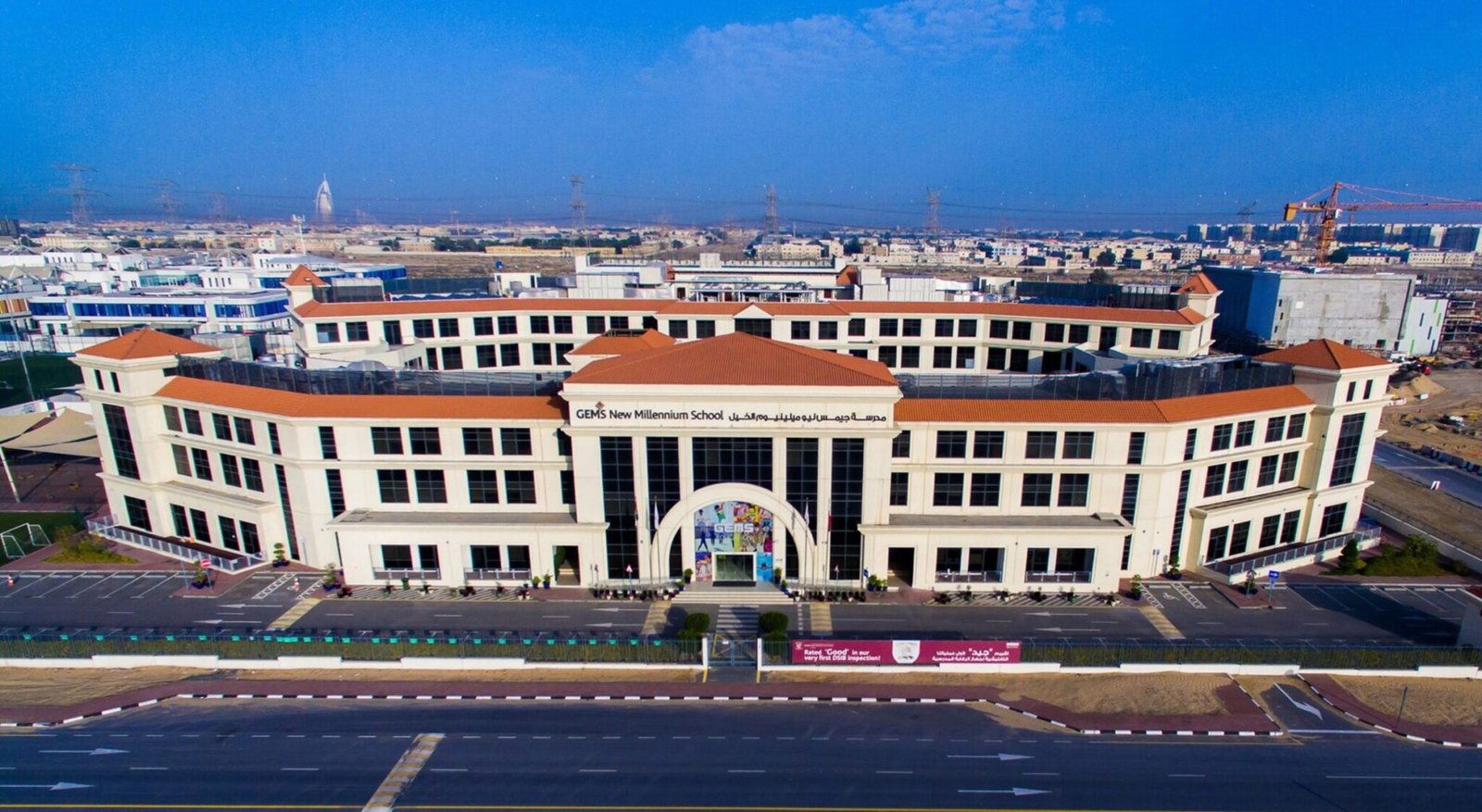
Featured image: “NMS.jpg” by Gemsnms alkhail, Wikimedia Commons, licence CC BY-SA 4.0. Cropping and design have been adapted; the adapted version is also licensed under CC BY-SA 4.0.