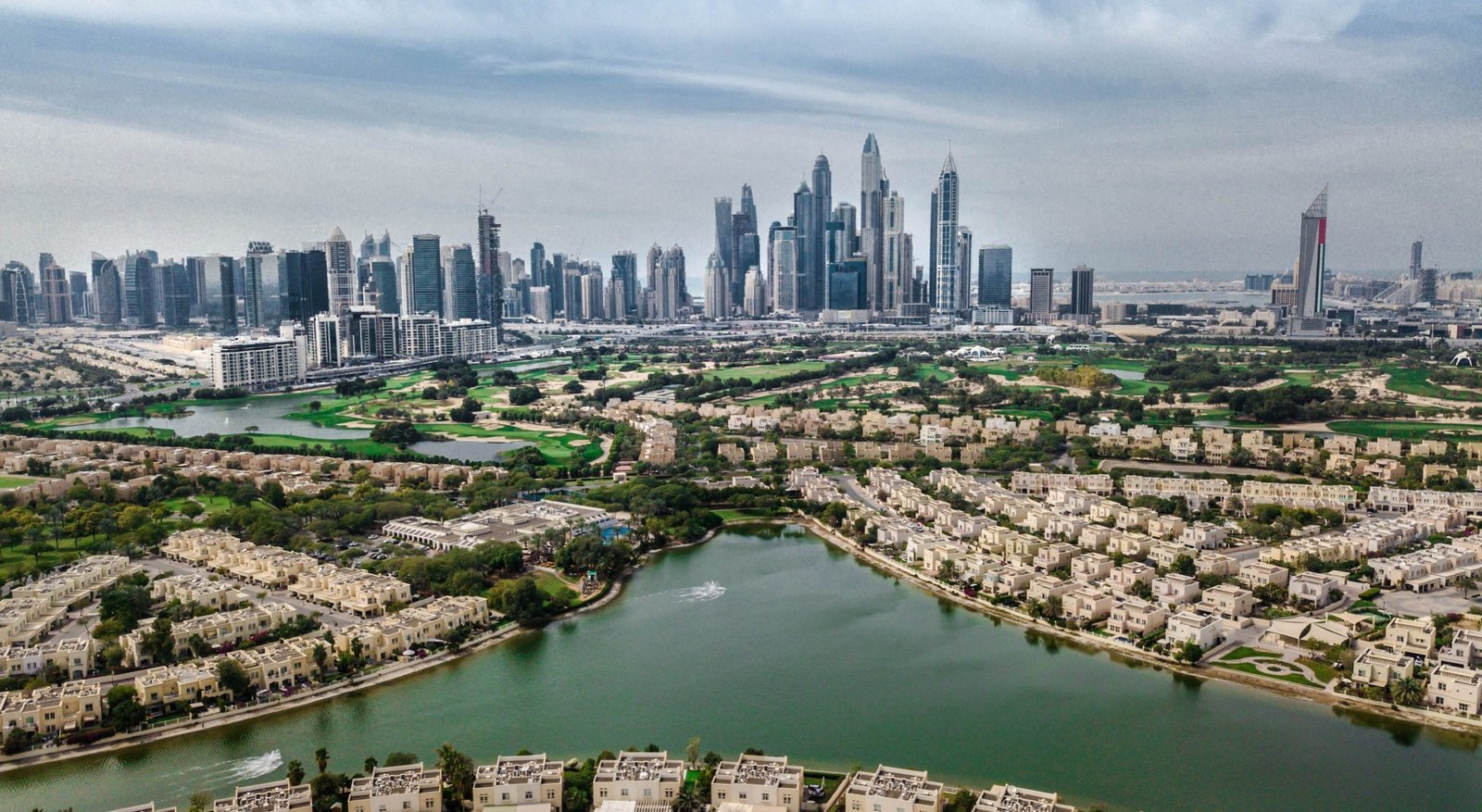
Retiring in Dubai is becoming an interesting option for more and more people from Germany, Austria and Switzerland who want to spend their retirement abroad. Year-round sunshine, no personal income tax in Dubai and a special residence visa for retirees make the city attractive. At the same time, there are financial, tax and legal requirements that should be checked carefully before the move.
This guide shows who qualifies for the Dubai Retirement Visa, what it costs, what to look out for with health insurance in later life and what actually happens to your German, Austrian or Swiss pension when you move your retirement to Dubai.
Table of contents
Retiring in Dubai: requirements at a glance
| Criterion | Requirement |
| Minimum age | 55 years, plus at least 15 years of work experience (in the UAE or abroad) |
| Financial proof (one of the options) | Property worth at least AED 1 million (approx. €243,000) OR savings of at least AED 1 million (approx. €243,000) OR a fixed annual income of at least AED 240,000 (approx. €58,200) (≈ AED 20,000 (approx. €4,850)/month) |
| Health insurance | Mandatory, valid for the UAE |
| Visa duration | 5 years, renewable if eligibility continues |
| Responsible authority (Dubai) | GDRFA – General Directorate of Residency and Foreigners Affairs |
| Income tax on pensions in Dubai | 0% (Dubai does not tax private income) |
| Tax liability in your home country | depends on the complete surrender of residence and, where applicable, a DTA |
Important upfront: the Retirement Visa is not the only way to secure your retirement in Dubai legally – for wealthier emigrants, the Golden Visa via a property investment can also be an alternative (see below).
Why retire in Dubai? Advantages and disadvantages
For retirees from the DACH region, three factors in particular speak for Dubai: the year-round warm, dry climate, the internationally excellent medical infrastructure in the large hospitals, and the fact that Dubai itself does not tax pensions, investment income or other private income. Add to this a high level of safety compared with many major European cities and an established, well-connected German-speaking community.
These advantages are offset by real limitations that are given too little attention in most guides:
- The summer months (June to September), often with temperatures above 40 °C and high humidity, are a serious strain, especially for older people with circulatory or respiratory conditions.
- Health insurance becomes noticeably more expensive with age and – unlike in Germany, Austria or Switzerland – is not financed on a solidarity basis, but calculated purely on risk.
- And finally, the distance from family in your home country remains a factor that is often underestimated when deciding on retirement, especially when health support becomes more relevant in later life.
You can find a structured overview of all residence models in Dubai – not just for retirees – in our Dubai visa guide.
The Dubai Retirement Visa in detail
Requirements according to GDRFA Dubai
Anyone who wants to retire in Dubai must meet certain requirements. According to GDRFA Dubai (General Directorate of Residency and Foreigners Affairs), the authority responsible for residence permits in Dubai, the following core requirements apply to the Retirement Visa:
- Minimum age: 55 years, plus at least 15 years of work experience (in the UAE or abroad).
- Financial proof, via one of three routes: property worth at least AED 1,000,000 (approx. €243,000), a deposit of at least AED 1,000,000 (approx. €243,000) with a financial institution based in the UAE (transfer within 60 days) or a fixed annual income of at least AED 240,000 (approx. €58,200) (≈ AED 20,000 (approx. €4,850)/month).
- Health insurance: valid health insurance that meets UAE requirements is a prerequisite for the visa to be issued.
Note on differing information:
The federal portal u.ae cites different figures for applications outside Dubai in some cases (for example an annual income of AED 180,000). For applications in Dubai, the GDRFA Dubai requirements listed above apply. As visa conditions can change, the currently valid amounts should be confirmed directly with GDRFA Dubai before applying.
Required documents
The document requirements differ depending on the chosen route:
- For property ownership: passport copy and proof of ownership or a current valuation by the responsible Land & Property Department.
- For a bank deposit: passport photo, passport copy, confirmation of the deposit and proof of the transfer.
- For proof of income: passport photo, passport copy, bank statements for the last six months and proof of income from an official body (e.g. the pension insurance provider).
Fees and validity
According to GDRFA, the fees for the permit include a basic fee of AED 200 (approx. €49), a “knowledge dirham” (AED 10 (approx. €2)), an “innovation dirham” (AED 10 (approx. €2)), an in-country processing fee (AED 500 (approx. €121)) and a delivery fee (AED 20 (approx. €5)); for the 5-year residence card, there are further fees for residency (around AED 2,280 (approx. €553)) and the Emirates ID (around AED 575 (approx. €140)).
These figures may change – a current fee overview should be obtained directly from the authority.
The visa is valid for five years and can be renewed as long as the financial requirements continue to be met.
Alternative for the wealthier: Golden Visa via property investment
Anyone with a property investment of at least AED 2,000,000 (approx. €485,000) can also apply for the Golden Visa instead of the Retirement Visa – with the advantage of a validity of up to 10 instead of 5 years and no fixed age limit.
You can find details and requirements in our Dubai Golden Visa guide.
What happens to your pension when you move to Dubai
Anyone who wants to retire in Dubai should clarify early what happens to their existing pension, as this point is decisive for financial planning.
The basic rule for Germany, Austria and Switzerland: a pension once acquired is generally still paid out when you live in the United Arab Emirates. What may change are the reporting obligations towards the respective pension provider and the tax treatment.
For the basic rules on deregistering your residence, exit taxation and the respective deadlines in Germany, Austria and Switzerland, see our detailed article Deregistering from Germany, Austria and Switzerland when moving to Dubai.
The following sections focus specifically on the particularities for retirees.
Germany: pension payments, life certificate and taxation
According to the German Pension Insurance (Deutsche Rentenversicherung), the statutory pension generally continues to be paid when you live in the UAE.
One particularity concerns only certain historical contribution periods (such as contribution periods in the former German Reich territory or under the Foreign Pensions Act): these are not paid out if you live outside the EU, the EEA or Switzerland, which can slightly reduce the pension in these – mostly older – individual cases.
For a regular pension acquired in Germany without such special periods, the amount generally does not change.
Two obligations are important in practice:
- Timely notification: The Renten Service of Deutsche Post AG should be informed of the new bank details at least two months before the move so that payments continue without interruption.
- Annual life certificate: Pensioners living abroad must submit a life certificate to the Renten Service every year – either via the digital life certificate (DLN) or in person at the Consulate General in Dubai.
For tax purposes:
Since 2005, pensions from the statutory pension insurance have generally been subject to limited tax liability in Germany even if you live abroad; the responsible office is the Neubrandenburg tax office, set up specifically for pensioners abroad. As there is no double taxation agreement between Germany and the United Arab Emirates – as explained in our deregistration article – the German pension generally remains taxable in Germany.
You can find more on the basic tax classification of Dubai in our article Dubai taxes.
Source: Deutsche Rentenversicherung – Is the pension paid in full abroad?.
Austria: pension, life confirmation and limited tax liability
According to the Austrian Pension Insurance Institution (PV), the Austrian pension is generally transferred to almost every country in the world, on the first of the following month – we are not aware of any reductions for residence in the UAE either.
However, an annual life confirmation is mandatory and must be submitted by mid-June at the latest; the UAE is not covered by the exception for countries with automatic matching of death data, which is why the confirmation is actually required again every year. If the deadline is missed, pension payments may be temporarily suspended.
For tax purposes, pension recipients without an Austrian residence are subject to limited tax liability. As there is a double taxation agreement between Austria and the United Arab Emirates, taxation may, under certain conditions, take place exclusively at the new place of residence – this usually requires a certificate of residence from the UAE tax authority.
The change of residence itself must be reported within two weeks.
Source: Pensionsversicherungsanstalt – pension abroad.
Switzerland: AHV, pension fund and life certificate
We have already covered the particularities of voluntary continued AHV insurance and the capital withdrawal from the pension fund when moving to a third country such as the UAE in detail in our article on deregistering from Switzerland.
In addition, the following applies to AHV pensions already being paid:
Since 2022, the annual life certificate for Swiss abroad has no longer been required in certain cases, for example when registered with a Swiss representation or in countries with automatic exchange of death data. For the UAE, according to current information, the certificate is generally still required, but can be submitted electronically.
As these rules can change, it is advisable to register in the register of Swiss abroad and to check directly with the responsible compensation office.
Source: swissinfo.ch – AHV abroad: when is a life certificate required?.
Health insurance in retirement: what seniors need to look out for
As described above, valid health insurance is a mandatory requirement for the Retirement Visa. For seniors, there are some particularities that do not appear in most general guides:
- Entry age limits differ greatly depending on the insurer. Some international providers currently have no fixed age limit for new customers, while others only accept new customers up to 70 or 75. The older you are, the smaller the choice of available plans.
- Pre-existing conditions do not automatically lead to exclusion, but are treated differently: some insurers exclude the condition from cover, some charge a risk surcharge, and some include it fully under certain conditions.
- Premiums rise noticeably with age, as health insurance in the UAE is calculated on a risk basis rather than a solidarity basis.
For these reasons, you should obtain specific quotes from different insurers early – ideally several months before the planned move – and openly declare any existing pre-existing conditions.
You can find all the basics on mandatory insurance, costs and common providers in Dubai in our article Health insurance in Dubai.
Retiring in Dubai: what are the living costs?
Budgeting with a pension rather than a salary has its own particularities for retirees: there is no ongoing employment to base the budget on, while rent, health insurance and healthcare costs become more important. According to our cost of living guide , monthly expenses for a couple without children – the typical situation in retirement – are around €4,000 to €7,000, with rent alone accounting for 30 to 50% of the budget.
As Dubai levies no local tax on pensions or other private income, more of your disposable income remains at the end of the day than in most European cities – provided that tax liability in your home country has been properly clarified as described above.
Housing in retirement: buy or rent?
Anyone who wants to retire in Dubai often faces the decision of whether to buy a property or rent first. Many retirees decide to buy – not least because property ownership can be relevant for the Retirement Visa or the Golden Visa (for an investment of at least AED 2 million – approx. €485,000) under certain conditions.
Anyone who initially only wants to try living there should rather rent for the first one to two years and only consider buying once they know the area well enough.
We have summarised all the legal and financial details of buying property in Dubai – from the property search to registration in the land register – in our guide to buying property in Dubai.
Checklist: planning your retirement in Dubai in a structured way
- Check your personal eligibility for the Retirement Visa (age, property/deposit or annual income) and have the currently valid amounts confirmed directly by GDRFA/ICP.
- Obtain several health insurance quotes early, especially if you have pre-existing conditions.
- Inform the Renten Service (Germany) or the responsible pension/compensation office (Austria/Switzerland) of your new address abroad and bank details at least two months before the move.
- Clarify the tax situation of your pension with a tax adviser – especially whether and how the pension will continue to be taxed in your home country.
- Inform the registration office in your home country on time and complete the deregistration of your residence fully (see our deregistration guide).
- Submit the visa application and provide proof of health insurance.
- Clarify your housing situation: rent first or buy straight away.
- Set up processes for the annual life certificate/life confirmation (digital life certificate, appointment at the consulate or electronic submission) so that pension payments are not interrupted.
Retiring in Dubai: the 5 most common mistakes
Mistake 1: Only clarifying health insurance shortly before departure. Especially with pre-existing conditions, finding a suitable plan can take weeks – and it is also a prerequisite for the visa.
Mistake 2: Forgetting the annual life certificate/life confirmation. If it is missed, pension payments can be temporarily suspended – in all three countries.
Mistake 3: Assuming that the pension is automatically tax-free in Dubai. Dubai itself does not tax pensions, but your home country may continue to do so – especially Germany, which has no double taxation agreement.
Mistake 4: Relying solely on third-party information about visa amounts. As figures vary between sources, current confirmation should always be obtained from GDRFA/ICP before applying.
Mistake 5: Underestimating summer temperatures. Anyone whose health is sensitive to heat should ideally have experienced the summer months on site before making a final decision.
Conclusion: who retirement in Dubai is really worthwhile for
Retiring in Dubai can be an attractive option for people from Germany, Austria and Switzerland to shape their later years anew. If the requirements are met, the Dubai Retirement Visa offers long-term residence status, while Dubai itself levies no personal income tax on pension income.
However, rising health insurance costs in later life, living costs and possible continued tax liability in your home country in particular should be taken into account.
Anyone who carefully reviews their financial situation, takes the requirements of the pension providers into account and confirms the current visa conditions directly with the responsible authorities lays a solid foundation for retirement in Dubai.
Matching tools
FAQ: frequently asked questions about the retirement visa and retiring in Dubai
From what age can I apply for the Dubai Retirement Visa?
From the age of 55 with at least 15 years of work experience, provided you also meet one of the three financial requirements (property worth AED 1 million, a deposit of AED 1 million or a fixed annual income of AED 240,000) and have valid health insurance.
Do I have to own property in Dubai for the Retirement Visa?
No. According to GDRFA Dubai, a provable fixed annual income of at least AED 240,000 (approx. €58,200) is also sufficient. Property, savings and income are equivalent routes; one of them is enough.
Will my German/Austrian/Swiss pension still be paid if I move to Dubai?
Yes, generally in all three countries. You only need to observe reporting obligations (new bank details, new address) and submit an annual life certificate or life confirmation.
Do I have to pay tax on my pension in Dubai?
No, Dubai does not tax pensions or other private income. However, tax liability in your home country may continue independently of this, especially in Germany.
How expensive is health insurance for retirees in Dubai?
That depends heavily on age, state of health and insurer. Premiums rise considerably with age, and some insurers set age limits for new customers of between 70 and 75.
Can I use the Golden Visa instead of the Retirement Visa?
Yes, with a property investment of at least AED 2 million (approx. €485,000), the Golden Visa is also an option – with a validity of up to 10 years and no fixed age limit.
What happens if I forget the annual life certificate?
In this case, pension payments may be temporarily suspended until the certificate is submitted.
Do I need a tax adviser to plan my retirement in Dubai?
It is not mandatory, but given the different taxation of pensions in the home countries and the lack of a double taxation agreement (especially for Germany), individual advice is strongly recommended.
Note:
The information in this article is based on publicly available information from GDRFA Dubai, the German Pension Insurance, the Austrian Pension Insurance Institution and Swiss compensation offices (as of September 2026).
It is intended for general guidance and does not replace individual legal, tax or pension advice. As visa conditions, fees and pension rules can change, the specific implementation should always be agreed with the responsible authorities and a tax adviser in the respective home country before moving to Dubai.